


“Fluid Venus Vienna”,
Curated by Anne Avramut
Room of Fine Arts, Vienna 2025
Fluid Venus presents a new series of works by Ines Valentinitsch in which painting, sculpture, and the body meet in a radical continuum. The starting point is the watercolors, whose transparency and flowing lines offer an initial approach to the female body. From these develop glass objects that translate this delicacy into a sculptural materiality: organic volumes, translucent and vulnerable, yet simultaneously charged with an eruptive physicality.
The glass figures mark a crucial moment within Valentinitsch's practice. They draw on the vocabulary of transparency, fragment, and surface, while also bearing an explicit iconography of the body. Nipples appear as formal markers that inscribe a clear, feminine signature onto the amorphous volumes. The works thus exist within a field of tension between eroticism, vulnerability, and self-assertion. What becomes visible is a body that simultaneously remains fragment, object, and image, and whose presence is renegotiated within the media contexts of social media, censorship, and self-presentation.
The oil paintings connect to these sculptures and intensify their themes. Here, the female body unfolds in a sculptural painting style that emphasizes the organic, the fleshy, and the deformed in equal measure. Breasts appear in unexpected places, heads and embryonic forms burst forth from the picture plane. The paintings are reminiscent of prehistoric depictions of Venus without a head, focusing on breasts, abdomen, and genitalia as archetypal symbols of fertility and vitality. Valentinitsch's oil paintings are not merely continuations but intensifications: painting that does not depict the body but reinvents it in color and gesture.
Fluid Venus thus spans a range from delicate watercolors to glassy bodies and monumental oil paintings. The series explores how the female body transforms through the changing media – from translucent image to fragile sculpture, from sculpture to painting made flesh. The result is a cycle of works that makes the body visible as a site of transformation, sensuality, and existential presence.


“Fluid Venus Venice”,
Curated by Mariangela Calisti
Palazzo Mora, Venice 2026
“Fluid Venus”
Ines Valentinitsch paints corporeality through undefined bodies, often marked by ambiguity rather than fixed sexual identity. In her watercolours, bodies become fluid, fragmented, and expanded, resisting stable references and categories. What emerges is the sensual and vital core of the human being: sensuality as impulse, emotion, and an unconscious force shaping us since infancy.
Since 2025, she has also worked with glass, a sculptural medium that is difficult to control and inherently unpredictable. Yet her glass works remain remarkably balanced and coherent with her painterly language. The body persists even in abstraction, retaining an immediate evocative power. The blurred quality of watercolour finds a parallel in the transparency of glass, where bodies preserve their fluidity and indeterminacy. Traces of red beneath the surface, like veins or blood, animate curved forms defined not by reference, but by pigment, matter, and poetry.
Her performances extend this language into a silent dialogue of bodies and gestures, translated into broad, expressionist brushstrokes charged with vulnerability and presence.
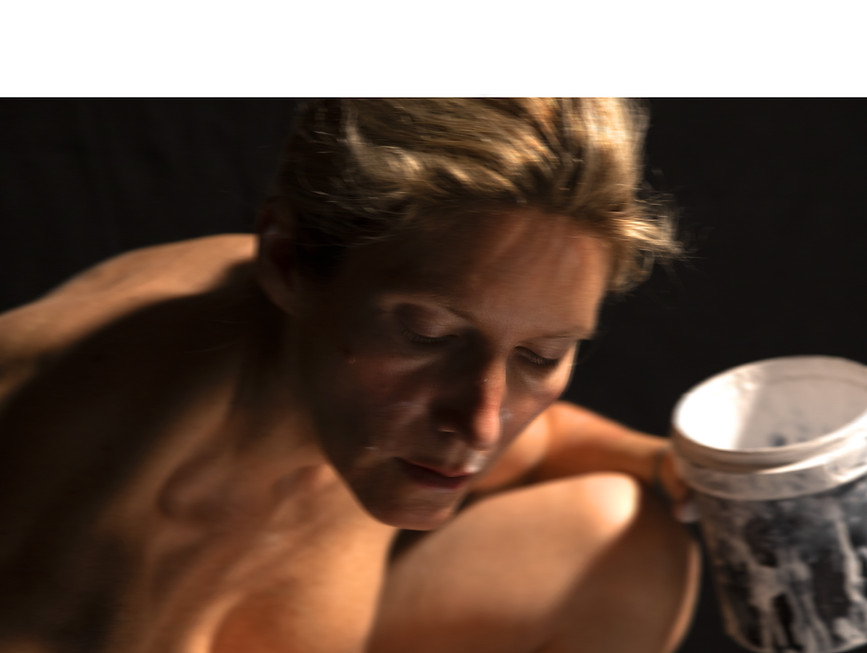
The naked Chameleon
With my art I make the intangible visible.
It’s the essence, the energy I am interested in - an other being or nature.
I connect to this essence on a higher level,
that way creating becomes a spiritual act.
It’s all about connecting to my surrounding, about nourishing and enhancing the experienced energy and feeding it back into the life cycle.
This transformation of energy through my art mirrors myself and with every piece of work my inner self also changes.
I am like a naked chameleon that becomes a canvas.

I look at you.
Your eyes are closed.
We are floating on the water.
You are floating.
I watch your toes — they are bluish.
Your body starts to move slowly, like the waves of the water.
It seems you are suspended in the air.
Your skin twitches in the soft wind.
I feel the evening sun on my shoulders.
I begin to catch your motion with quick lines on the paper.
As I draw your face, your body, I move slowly—slowly beneath your skin,
ever deeper, connecting with your inner being.
Nothing feels more true or real to me.
I hold my breath for a while — I record your energy.
Like lungs aligning with the air they breathe, I adapt every stroke of color to your motion.
We are floating.
Your vital energy reflects onto the paper, without reference to the surrounding world.
Like a rhythmic dance, I become your extension — step by step, your reflection takes form.
This is beauty.
This is beautiful.
Be you to the full.
SELECTED PERFORMANCES
REFLECTING BODY
in collaboration with Paola Ponti,
Palazzo Bottigella Gandini Art Lab, Pavia (2024)
FLUID VENUS
in collaboration with Veronica Vetrila e Palazzo Bottigella Gandini Art Lab,
Canal Grande, Venice (2026)
BE YOU TO THE FULL
in collaboration with Veronica Vetrila and Marek Jason Isleib,
Palais Dietrichstein, Graz, Austria (2025)
BECOMING SPACE
in collaboration with Alexandra Cassirer and Women Without Borders at the Atelier House of the Academy of Visual Art Vienna/Semperdepot, Austria (2023)
MORPHOLOGY
in collaboration with Rino Indiono, EDB Contemporary,
Palazzo Clari, Venice (2024)
SELECTED EXHIBITIONS


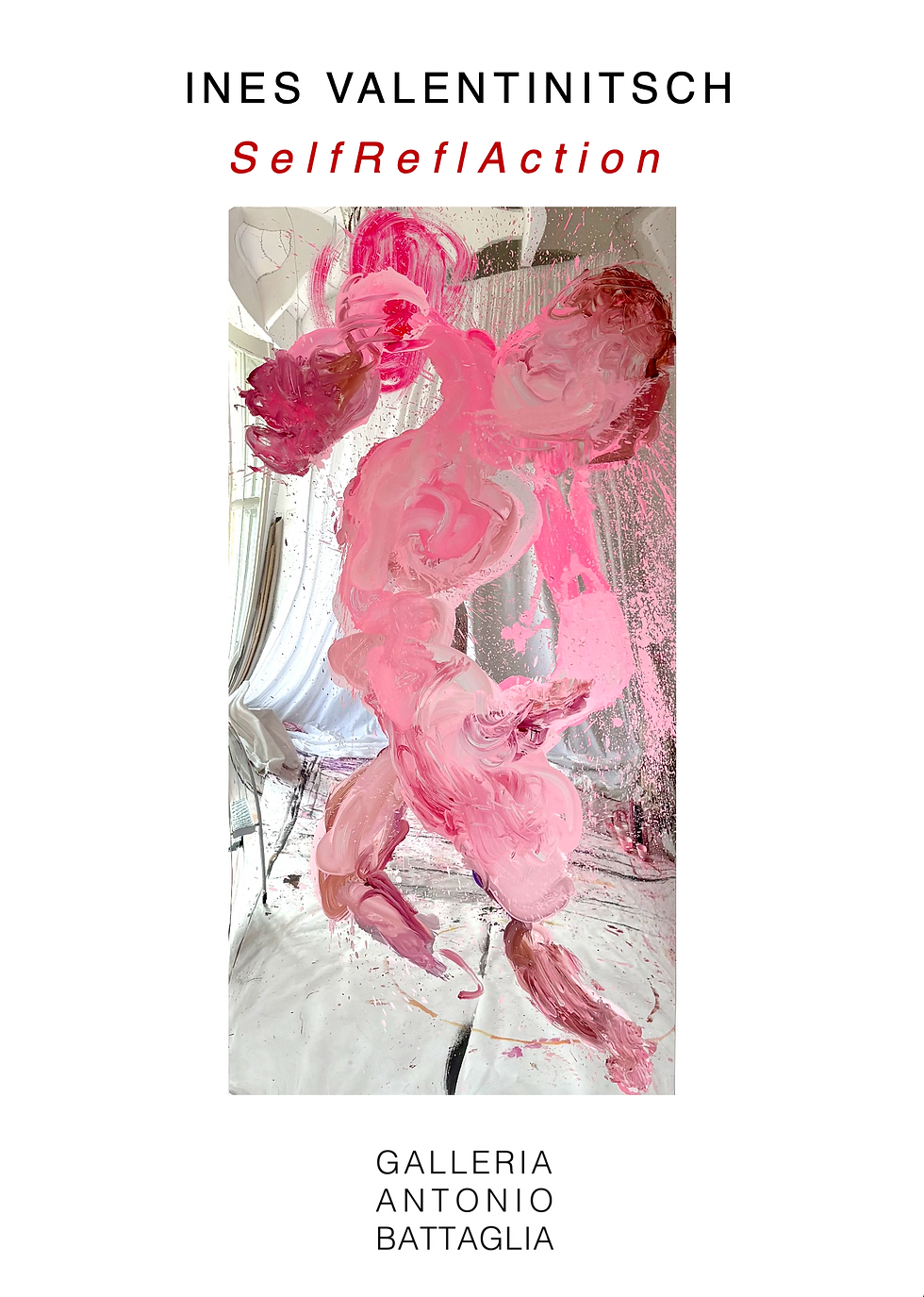
“SelfReflAction”
Curated by Antonio Battaglia
Galleria Antonio Battaglia,
Milano 2025
La Galleria Antonio Battaglia
ha il piacere di inaugurare una nuova mostra personale di Ines Valentinitsch, la seconda in galleria. Oggi il suo lavoro si libera completamente in un gesto espressionista di grande forza che unisce il corpo dell’artista stessa alla pittura, attraverso performance da lei effettuate nell’atto del dipingere esprimendo grande forza comunicativa dell’immagine in relazione al movimento e alla percezione del corpo.
In quest’occasione i supporti utilizzati dall’artista sono superfici specchianti in cui è sempre presente una figura femminile, autoritratti e ritratti che, nell’azione del dipingere, si riflettono tra le profondità sensibili della pittura. Negli ultimi lavori concepiti per la mostra alcune parti di queste figure si staccano dalle superfici bidimensionali e diventano forme amorfe sagomate sul supporto in pvc a specchio; fluttuano così nello spazio sconfinando anche nella scultura.
Nelle sue performance il corpo, con le sue caratteristiche anatomiche e le proprie naturali nudità, riprende una classicità e sensualità quasi neoclassica, in cui la femminilità è protagonista.
Fino al 10 luglio 2025, in Austria a Graz nella sua città natale, è in corso una mostra alla Galleria Room of Fine Arts, in cui Ines, insieme alla danzatrice espressionista Veronica Vetrila e il musicista Marek Jason Isleib, ha realizzato una performance con una serie di dipinti che traducono i movimenti dei corpi “allo specchio” costruendo un’ installazione di Pittura Ambiente in un fil rouge con la mostra SelfReflAction a Milano, titolo che è stato scelto dall’artista, come indicazione del suo processo creativo.
Nel 2024, nella mostra Reflecting body, a cura di Mariangela Calisti e Christian Marinotti, a Palazzo Bottigella Gandini Art Lab, Pavia, Ines Valentinitsch ha collaborato con l’artista performer, Paola Ponti, nella realizzazione di un palcoscenico pittorico in cui il ritmo della danza convive con il ritmo della pittura. La performance è stata accompagnata da vere e proprie video installazioni che sottolineano l’interazione poetica tra le due performer nel formare un tutt’uno della loro energia creatrice. Il video documentario della performance sarà esposto in galleria come testimonianza del percorso pittorico performativo di Ines Valentinitsch.
Galleria Antonio Battaglia is pleased to present a new solo exhibition by Ines Valentinitsch, her second at the gallery. In this latest body of work, the artist fully embraces an expressionist gesture of striking intensity that merges her own body with painting, through performances carried out in the act of painting. These performances convey a powerful communicative force, linking imagery to bodily movement and perception.
For this exhibition, the artist has painted with oil on organically shaped mirrored surfaces, featuring the female body as self-portraits or portraits. These mirrored surfaces are suspended from the gallery ceiling, floating in space and entering the realm of sculpture and installation. They create an experience of amorphous female body sensitivity, experimenting with color, form, depth of space, and light. The installation also involves the viewer, who becomes part of the artwork through their own reflection
In her performances, the body, with its anatomical features and natural nudity, recalls a near-neoclassical sense of sensuality and classicism, where femininity takes center stage.
Until July 10, 2025, Valentinitsch is also exhibiting in her hometown of Graz, Austria, at the Room of Fine Arts Gallery. There, in collaboration with expressionist dancer Veronica Vetrila and musician Marek Jason Isleib, she was live performing alongside a series of paintings that translate mirrored body movements into an "environmental painting" installation. This project shares a conceptual thread with SelfReflAction in Milan, a title chosen by the artist to represent her creative process.
In 2024, for the exhibition Reflecting Body, curated by Mariangela Calisti and Christian Marinotti at Palazzo Bottigella Gandini Art Lab in Pavia, Valentinitsch collaborated with performance artist Paola Ponti to create a painterly stage where the rhythm of dance harmonized with the rhythm of painting. The performance included video installations emphasizing the poetic interaction between the two performers, forming a unified creative energy. A video documentary of this performance will be on view at the gallery as a testament to Valentinitsch's performative painting journey.


Be you to the full
Monika Holzer-Kernbichler
The movement of the body before her, synchronized with the music, is internalized through the perception of its expression and directly translated into the image. Body, light, shadow, colour—everything is reduced to its essence. This shared moment generates the energy that Ines Valentinitsch captures in rapid, small-format sketches, then applies to the canvas in glazes, spanning the dancer's full-length figure. The colour flows like the dancer herself; her movements arise in response to the music, which in turn responds to the movements. The performance thrives on this shared moment, on engaging with one another in time and space, on seeing, feeling, hearing, and translating onto the canvas. The two artists communicate implicitly through the music.
The historic space of the Palais Dietrichstein in Graz is darkened beneath the baroque secco-painting, which, amidst the opulent stucco, only hints at Ovid's Metamorphoses. In the blackness of the room, the soft light casts a focused spotlight on the moving bodies. In the background, a filmic reflection of the scene plays. Female bodies interact, unclothed, sometimes in shadow, sometimes superimposed in individual scenes, all in black and white. A voice can be heard gently repeating "be you to the full" until only "be-au-ti-ful" remains.
Space
Ines Valentinitsch selects the spaces for her performances with great care. What they all have in common is a historical setting that is not perfect. The spaces are full of traces of their history, located in old palaces, having lost the splendor of a glorious past. In their full size, they recall their original, representative function. The empty space becomes a backdrop, a temporary stage, and a studio in which she seeks to capture the moving body in the moment on paper and the canvases that lie at hand. It also remains significant in the photographs and films that emerge from this process.
Dance
The dancer performs without a script, guided by a narrative that speaks of very personal, emotional experiences. This expressive Japanese dance, called Butoh, is always a highly expressive, emotional performance. With powerful gestures and slow movements, the formless, relentlessly physical dance appears austere and mysterious. It is also called the black dance, in which the body functions as an instrument of transcendental metamorphoses and transformations between different worlds. Butoh draws on the body's memory, which is shaped genetically, biographically, and culturally. The power of the unveiled body is very direct; it resonates within the narrative, whose impact arises primarily from reduction. The dance intensifies in the large, expressive images of the film in the background, culminating in a silent scream. Without words, one sensitively experiences vulnerability and injury.
Body
The dancing body in Butoh is naked, often covered with white paint to shift the focus from nudity to its sculptural, artistic form. "The body sometimes constricts me," says Ines Valentinitsch, and yet at the same time she liberates it from all external constraints. She, too, is unclothed while painting and is always present on stage as the counterpart to the dancer and the audience. Here, however, the white paint does not cover the dancer's body, but is the paint with which the artist works the dark-primed canvases, capturing the dancer's movement, rhythm, and proportion at a rapid pace. Be completely yourself—be you to the full, freed from all external influences, vulnerably exposed to the power of each moment in the flow of the unfolding process.
Nude
Ines Valentinitsch paints nude, even when she works alone in the gallery space. The uncovered body is an enormous projection surface for art historical perspectives as well as for voyeuristic anticipations. Do you love me or do you love my body?
In European art history, the female nude body has appeared in many different forms of expression since at least the depictions of goddesses in antiquity, mostly idealized, corresponding to the beauty ideals of the respective era, and often eroticized. Nudity is never neutral. In the sinfulness of the Christian Middle Ages, the exposed body represents temptation, becomes a moral danger as Eve, and in the depicted purgatory, a warning against vice. In modernity, physicality detaches itself from the symbolic, losing its transcendent and earthly dimensions in favour of immediate realities. Women become visible as models and serve as subjects for nude studies in painting education. For precisely this reason, female artists were long denied access to academies. The study of nude bodies was considered morally reprehensible for women (from good families). As a nude (and socially insignificant) model, her services are simultaneously sought after. For a long time, the male gaze determined how nude women were depicted in art and thus how they were perceived. Through liberation from this objectification, the naked female body is increasingly subjectified. Female artists recognize it as a political field, employing it—as Marina Abramovic does—in performances, even to the point of (self-)harm, and completely exposing it completely. It is about the right to self-determination and the demand for self-empowerment. The female body is political, especially when it comes to power relations, reproductive capacity, and caregiving.
Through her art, Ines Valentinitsch liberates herself from many internal and external constraints. Self-empowerment, independence, and letting go of beauty ideals allow her to concentrate on her innermost being—without fashionable expression and without constructing an external identity. Her approach is less extroverted, less exposed, and more expressive and immediate, both representational and painterly. She clearly contradicts the assumption that nudity is synonymous with a promise of pleasure, demonstrating that a naked body is not inherently suggestive. It is what it is: liberated and vulnerable, radically exposed, both physically and psychologically.
Freedom
Feminism has understood the female body as a site of oppression, as a place that becomes political when patriarchal forces control it. For Hannah Arendt, freedom begins with liberation from external constraints; for her, it is not an internal state but a public, political practice. The freedom to be free is therefore not a given. Being free from everything external enables the creation of something new and an action that can only be fully realized in community. For, according to Arendt, people can only ever be free in relation to one another. In a digital world, freedom is put to a severe test. Self-optimization and self-exploitation characterize a neoliberal psychopolitics that understands how to drive people toward permanent self-improvement. Newer internal constraints create a different kind of unfreedom. In the virtual and thus virtually infinite space of comparison, the (one's own) body is once again constituted as an object.
Ines Valentinitsch liberates herself from this for her painting. In doing so, it creates a space of freedom that reveals a timeless connection with one’s own self. That self one only encounters when one gives it the opportunity to simply be, without wanting and without judging, in order to observe what arises.
Images
Ines Valentinitsch's paintings emerge from the performative act, as a response to the dancer's movements and the music. Sometimes, she herself is the counterpart, her reflection, the subjective perception of her own body in that moment. Her paintings are large-format, rendered on canvas with powerful gestures, drawn with quick strokes on paper, or delicately applied in watercolor. Many of her works are created as series. Ines Valentinitsch understands body proportions, knows what matters, and shifts them in the moment of perception. In the watercolors, where pink dissolves into sharply defined fields of color, the boundaries of the body blur, becoming soft and emphasizing their femininity. They are reminiscent of Marlene Dumas's depictions of the body, which are often perceived as naked, vulnerable, but also erotic and unsettling.
Günther Brus, who supported Ines Valentinitsch in her artistic career, understood his body as a means to art, as raw material and a vehicle for expressing existential experiences. With his actions, he pushed the boundaries of art, society, and above all, his own. While Günther Brus abandoned the canvas as a medium to attack the bourgeois concept of art, Ines Valentinitsch explores socially prescribed notions of the body, which she deconstructs through her painting and performances. She strips the body of its aesthetic shell and gives its essence her full attention.


“Reflecting Body”
Curated by Christian Marinotti e Mariangela Calisti
Palazzo Bottigella Gandini Art Lab, Pavia 2024


“Morphology”
Curated by Elisabeth de Brabant
EDB Contemporary, Palazzo Clari, Venice 2024
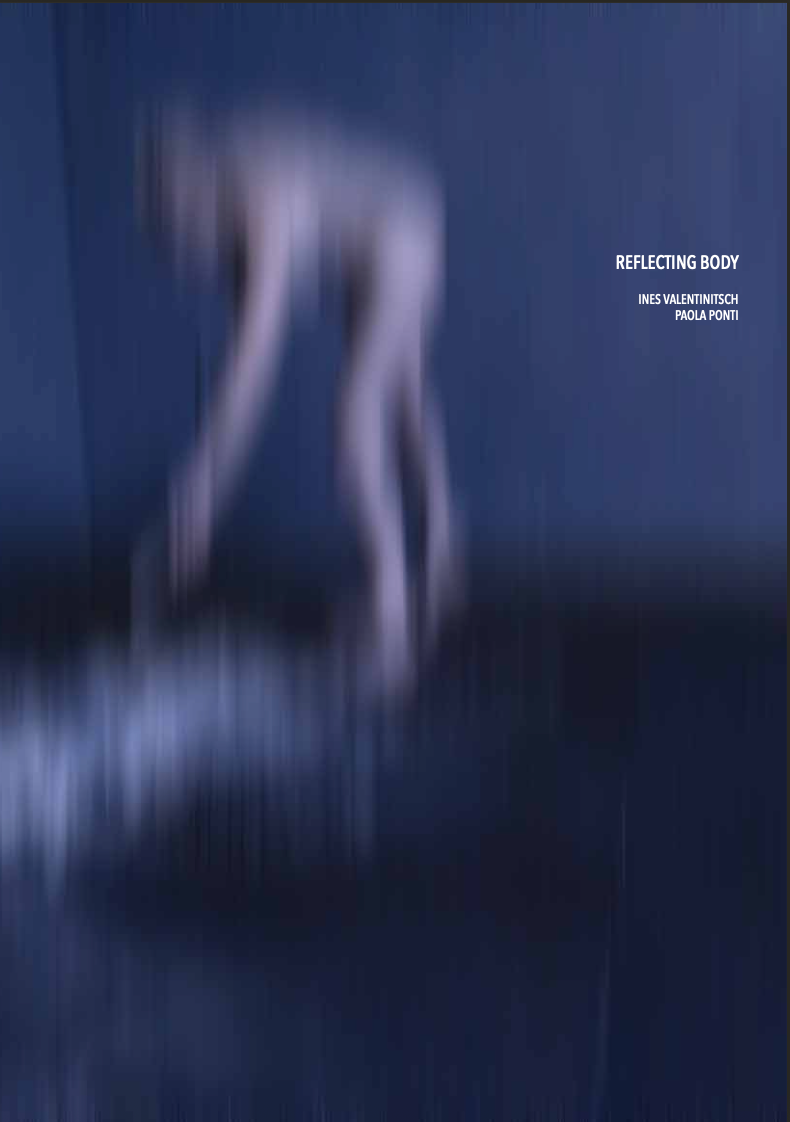
REFLECTING BODY IS A STAGE ACTION THAT DEVELOPS LIKE A DIALOGUE, A SILENT DIALOGUE BETWEEN BODIES IN MOVEMENT, AN INTERPLAY OF GESTURES THAT COMPARE AND TAKE MEASURE OF EACH OTHER.
THIS IS NOT A SIMPLE AND GENERIC PERFORMANCE - A TERM SO VAGUE AND EQUALLY OVERUSED – IT IS RATHER A THEATRE PLAY, A REAL “PIÈCE” WHERE THE SPOKEN WORD IS REPLACED BY ELOQUENT SILENCE VIBRATIONS OF THE EMOTIONAL TENSION EXPRESSED BY THE SLOW MOVEMENTS OF PAOLA PONTI, WHICH SEEM LIKE AN AWAKENING. CAUTIOUS MOVEMENTS OF A BODY THAT OPENS UP TO EXPLORE THE WORLD, TO FEEL ITS OWN BREATHING, THE BEAT OF LIFE. A SORT OF CATHARTIC RITUAL TO FREE ONE'S SELF FROM THE HIDDEN SCARS OF NEVER-ENDING SUFFERING, TOWARDS REBIRTH, BALANCE, HARMONY.
IN FRONT OF HER, AS A WITNESS AND AT THE SAME TIME AN ACCOMPLICE, INES VALENTINITSCH RECORDS EVERY PULSE, EVERY CHANGE IN THE POSTURE OF THAT NAKED BODY AND TRANSPOSES IT, TRANSCRIBES IT ON LARGE CANVASES WITH BROAD EXPRESSIONIST AND GESTURAL BRUSHSTROKES. INES PAINTS ON THE FLOOR, KNEELING, LIKE A JAPANESE PAINTER OF IDEOGRAMS. SHE PAINTS BODIES LIKE HAIKU OF THE FLESH THAT WANTS TO BECOME SPIRIT. SHE TOO IS NAKED ON STAGE, AS IF WANTING TO SHARE AND FEEL, ON HER OWN SKIN, PAOLA'S DISCOMFORT, PASSION, DISTURBANCE WHICH SHE TELLS ABOUT HERSELF WITHOUT INHIBITIONS, SHE DOESN'T ACT, SHE DOESN'T INTERPRET, SHE IS.
THE RESULT IS A JAM SESSION GOVERNED BY SPONTANEITY, BY THE ABSENCE OF RULES, BY PURE FEELING, DURING WHICH PAOLA AND INES WEAVE A TELEPATHIC RELATIONSHIP, TOTALLY TUNED INTO THE SAME EMOTIONAL AND SPIRITUAL FREQUENCY. IN PAOLA, THE GESTURE BECOMES FORM AND THAT FORM IS THE GRAMMAR TO UNDERSTAND THE TACIT LANGUAGE OF HER BODY. IN HER TURN, INES, WHO OBSERVES AND LISTENS - DRIVEN AND INVOLVED BY THAT DYNAMIC ACTION - SAVES AND HOLDS WITH HER BRUSHSTROKES THE STIMULI AND THE INFLUENCES THAT DERIVE FROM THE INNER EXPLORATION THAT PAOLA IS STAGING, AN AUTHENTIC EXCAVATION, WITHOUT PRETENCE, WITHOUT FILTERS, NOT EVEN WITH A DRESS.
JUST AS YOKO ONO IN ONE OF HER MOST FAMOUS PERFORMANCES DURING THE FLUXUS ERA (CUT PIECE, 1964) HAD HER CLOTHES METICULOUSLY REMOVED, PAOLA SEEMS TO REMOVE THE SKIN FROM HER SINUOUS BODY IN THOSE REPEATED CALM HARMONIOUS MOVES LIKE A MUSICAL ADAGIO.
A CALM FEELING OF THE AIR, PERCEIVING THE ELEMENTS, SCOUR THE OTHER FROM ONESELF, IN SEARCH OF A RENEWED ORIGIN, OF A NEW BEGINNING BEYOND THE LIFE CONSUMED, THE LIFE SUFFERED. THE RECIPIENT OF ALL THIS IS INES, EVEN BEFORE THE SPECTATORS, WHO WITH ALMOST SYNCOPATED AUTOMATISMS TRANSLATES IT INTO A SIGN, A STRONG, INTENSE SIGN, WHICH EVOKES PASSION, EMOTION, IN SHORT, PATHOS. A FOOTPRINT LEADS INES' PICTORIAL LANGUAGE TO MARLENE DUMAS, BOTH WOMEN, BOTH WITH ACCENTUATED SENSUALITY, BOTH INVESTIGATORS OF THE MOST HIDDEN IMPULSES OF FEMALE INTIMACY.
PERFECT IS THE CONNECTION OF LISTENING AND UNDERSTANDING BETWEEN PAOLA AND INES, CAPABLE OF GIVING LIFE TO AN EXERCISE OF INDIVIDUAL CONSCIOUSNESS THAT BECOMES COLLECTIVE, INVOLVING THE AUDIENCE IN A PRACTICE AS RAW AS IT IS SUGGESTIVE AND EVEN POLITICAL. A SUBTLE PLOT SEWS TOGETHER ALL THE MOMENTS OF THE SCENIC ACTION, REVEALING THE PAINFUL ATTEMPT TO PROCESS THE PAIN OF PAST EXPERIENCES; PAOLA’S STEPS ACTIVATE A MODE OF BODILY TRANSFIGURATION TOWARDS EMANCIPATION FROM THE SIGNS OF VIOLENCE, THREAT, OPPRESSION, SHAME, AND REJECTION THAT STILL OFTEN CONDITION WOMEN IN CONTEMPORARY SOCIETY. IN THIS WAY, PAOLA AND INES’S ARTISTIC PRACTICE AIMS TO GO BEYOND THE INNER AND POETIC DIMENSION, ALBEIT PRESENT AND SUGGESTIVE, AND, STARTING PRECISELY FROM THEIR SELF-EXPLORATION, TOUCH SOCIAL AND EVEN GENDER-RELATED CHORDS.
Solo exhibition of Ines Valentinitsch “Morphology”, April 17 - May 2, 2024
EDB Contemporary Palazzo Clary, Venice"Morphology" is a series of performative paintings. This new series further develops the artist's exploration in transformative dialogue with contemporary dancers.
Challenging her own memory and painting skills, Valentinitsch strives to capture the dynamic motions of another's body, harnessing and translating their energy.
These artworks represent an expansive live exploration into the contemporary perception of the body and sensuality, and examine the evolving societal roles of observer and performer.


“Becoming Space”
By Ines Valentinitsch and Alexandra Cassirer
Curated by Anna Shpilko
Atelierhaus der Akademie der bildenden Künste,
Vienna 2023
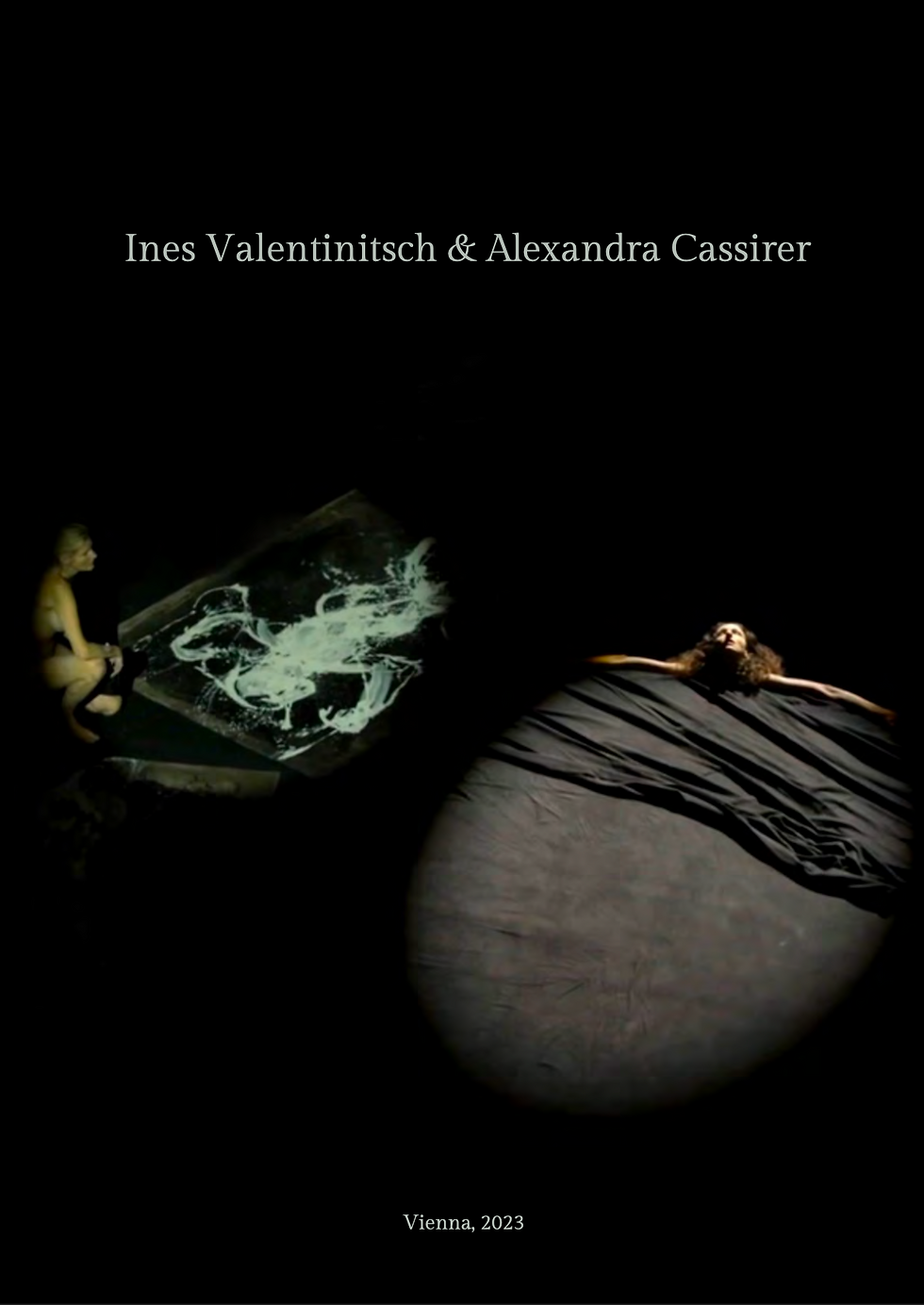
BECOMING-SPACE
Live art-performance by Ines Valentinitsch and Alexandra Cassirer in collaboration with B. LA Art Foundation and Women without Borders
Curated by Anna Shpilko Ravagli Presented by Mercedes Echerer
November 10th 2023, Atelierhaus Akademie der bildenden Künste Wien Lehargasse 8, Tor 2, 1060 Wien
BECOMING-SPACE is a site-specific performative live project that took place at Atelierhaus der bildenden Künste Wien on November 10th 2023. Two female artists of diverse backgrounds and at different stages of their lives undertake an ongoing transforming journey to address the biases imposed on women by society.
Ines Valentinitsch and Alexandra Cassirer expose to the public the most intimate process of creation, turning it into a time-based work of art. The transformative force they are looking for is in the liminal space. Their race with time is witnessed and validated by the third eye - that of the public. It's a space where vulnerability is transformed into power since everyone present is tuned in.
Sound Artist Shari De Lorian performs music during the live performance. Multiple layers from a selection of old and rare records merge with acoustic instruments from our past and clash with handmade industrial tools.